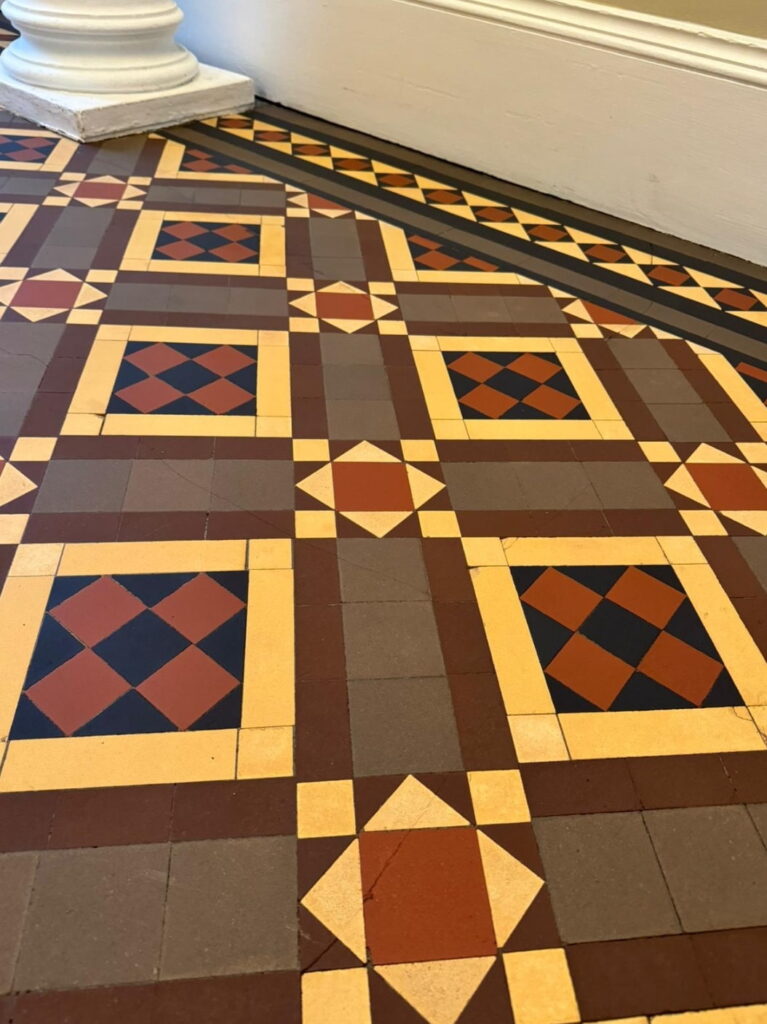
Hallway Floor

Parquet Covered Flagstone Floor Restoration Edinburgh Southside

Restoring a Parquet Covered Flagstone Floor in Refurbished in Edinburgh Southside

I was contacted by the new owners of a townhouse in the southside of Edinburgh who needed help restoring an old Flagstone floor. They had uncovered the flagstones beneath parquet flooring during renovations and the thick adhesive was proving problematic.

Flagstone floor during Parquet and Adhesive Removal Edinburgh Southside

The clients were keen to restore the floor as a feature of their oval-shaped reception hallway, which was a highlight of their home. They wanted to retain the natural, rustic charm without making it look artificially shiny.

I went over to take a look and could see that although structurally sound the stone was heavily soiled having absorbed decades of dirt and grime so once the glue had been removed it would need a deep clean. I worked out a detailed quote for restoring the floor, which was accepted and a date set.

Removing Parquet Adhesive from Flagstones

The first challenge was to remove the thick parquet adhesive and residues. To do this the thick parts had to be carefully scrapped off until it left a thin residue. Next a strong dilution of Tile Doctor Remove & Go which is a powerful coatings remover was sprayed onto the tiles. This was allowed to dwell and soak in for about twenty minutes to give it time to break down the glue. Then it was agitated with a heavy-duty rotary floor machine fitted with a coarse black scrubbing pad. The resulting slurry was then removed with a wet vacuum.

With the bulk of the residues removed, I turned my attention to deep cleaning the stone. For this a strong dilution of Tile Doctor Pro-Clean was applied and worked into the stone using the same rotary machine and another pad. The grout lines and edges were scrubbed manually using detail brushes to ensure a consistent clean.

The slurry was extracted using a wet vacuum gain, and the floor was thoroughly rinsed with water several times to remove any remaining residues. The floor was then left to dry naturally for a few days, aided by air movers.

Sealing an Indian Flagstone Hallway

Once dry, I tested for moisture using a moisture meter to ensure the stone was ready to be sealed. Tile Doctor Ultra-Seal was chosen for this; it’s a natural look sealer that doesn’t change the stone and which would give the completely natural appearance they wanted. It’s also a full breathable and ideal for use on flagstone and other natural stone floors in older properties where damp can be a concern.

Two coats were applied to ensure full coverage and protection; Ultra-Seal is an impregnator that works by occupying the pores in the stone ensuring dirt remains on the surface where its easily cleaned away.

The transformation was stunning. The once-dull and neglected stone now looked vibrant and full of character in keeping with the historic nature of the property. Additionally, the new seal will protect the floor against stains and dirt for many years to come.

Flagstone Floor After Restoration Edinburgh Southside

The clients were delighted and commented that the restored flagstone floor had become the centrepiece of their renovation. They were also reassured to know it would be much easier to keep clean for which I recommend Tile Doctor Neutral Tile Cleaner.

If you have a flagstone floor that could use some expert attention, whether it’s been recently uncovered or simply needs a refresh, get in touch. I cover Edinburgh and the surrounding areas.


Professional Restoration of an Indian Flagstone Hallway in Edinburgh

Restoring a Parquet Covered Flagstone Floor in Refurbished in Edinburgh Southside Read More »

Victorian Tiled Hallway Restoration Portobello Edinburgh

Victorian Tiled Hallway Deep Cleaned and Sealed in Portobello Edinburgh

This Victorian Tiled Hallway floor at a property in Portobello which is on the coast, East of Edinburgh. It had not been deep cleaned for some time and was looking very neglected. The owner felt it was time to get it renovated so we were asked to do the work.

Victorian Tiled Hallway Before Cleaning Portobello Edinburgh

Any sealer protecting the tiles had long since worn off resulting in dirt becoming ingrained into the pores where it’s very difficult to shift. The dirt had built-up in the tiles, and they were also stained with a few paint splashes from decorating.

Victorian Tiled Hallway Before Cleaning Portobello Edinburgh Victorian Tiled Hallway Before Cleaning Portobello Edinburgh

Additionally, there were three small tile repairs that were needed and some grouting to do. Happy to assist I came up with a restorative cleaning plan for the floor that was considerate of its age and provided a quote for doing the work.

Renovating a Victorian Tiled Hallway Floor in Portobello Edinburgh

Old floors like this one don’t have a damp proof membrane under the floor so you have to be wary of how much water you use during cleaning, if you use too much it could take a long time to dry out and you can seal it.

To start the cleaning I have the whole floor an Acid Wash using Tile Doctor Grout Clean-up. The product is applied to the floor and left to soak in for ten minutes before being worked in with low grit brushes fitted to a rotary buffer. Then after going over the floor a few times the floor was wiped with damp cloths and speed dried with air movers. The paint splashes had now been softened by the cleaning were be scraped off.

Victorian Tiled Hallway During Cleaning Portobello Edinburgh

Giving a floor like this an acid wash also has the advantage of neutralising any efflorescent salts in the tiles which can be an issue with old floors like this one.

With that complete I started with repairs which involved carefully removing the three broken tiles, cleaning up the base and then laying replacements which I had managed to source earlier. Your really have to be careful when removing tiles on a floor of this age as it doesn’t take much to upset the neighbouring tiles and before you know it your re-tiling a area much larger than you had originally planned for.

Once the replacement tiles had set and grouted in, I was able to move onto the next step of scrubbing the floor with a 200, 400 and then 800-grit Diamond burnishing pad. A little water is used to help lubricate the process which opens and then closes the pores on the surface allowing the dirt to be flushed out and makes the tiles slightly smoother. We find doing this also speeds up drying times. The water turns into a slurry which is removed with a wet vacuum after each pad is applied.

Victorian Tiled Hallway During Cleaning Portobello Edinburgh

Sealing a Victorian Tiled Hallway Floor

With the floor clean it was left to dry off for a week before returning to seal the tiles, applying a sealer to a damp floor can result in a cloudy appearance so it’s always best to wait.

The sealer chosen for this floor was Tile Doctor X-Tra Seal, it’s an oil-based long lasting breathable impregnator that’s rated for external as well as internal use; these are perfect credentials for a Hallway floor at the front of the house which is likely to get wet often.

The sealer brought the floor to life enhancing the deep colours giving the floor hardwearing protection that should last many years to come. The fresh sealer will ensure dirt remains on the surface where it can be cleaned away easily.

Victorian Tiled Hallway After Cleaning Portobello Edinburgh

Before leaving I took time to explain the importance of using a neutral pH tile cleaning product such as Tile Doctor Neutral Cleaner for day-to-day cleaning. A lot of products you find in supermarkets contain bleach and are simply too strong for cleaning a sealed surface and will quickly erode the sealer with use.

Victorian Tiled Hallway After Cleaning Portobello Edinburgh Victorian Tiled Hallway After Cleaning Portobello Edinburgh


Professional Restoration of a Victorian Tiled Hallway in Portobello Edinburgh

Victorian Tiled Hallway Deep Cleaned and Sealed in Portobello Edinburgh Read More »

Victorian Tiled Hallway Floor Renovation Edinburgh

Victorian Hallway Renovated using Low Moisture Cleaning in Edinburgh

Details below of a another Victorian Hallway floor restoration that we completed recently in Edinburgh. The owner of the property was unhappy with how dull the floor had become and was keen for it to be renovated back to health.

Old Victorian tiles are porous and so do need to be sealed to protect them from ingrained dirt and staining, unfortunately sealers don’t last for ever and do wear down with use so if you want to keep your floor looking clean you do need to maintain the sealer.

Victorian Tiled Hallway Before Renovation Edinburgh

I’ll add more detail below but in total this project took three days to complete as there were a lot of tiles that had to be lifted and fixed back down again, this was all done on the first day and once set the whole porch area had to be regrouted.

Renovating a Victorian Tiled Hallway Floor in Edinburgh

As mentioned above the first day was spent ensuring the tiles were secure. This involved checking every tile by hand in the hallway and porch floor and identifying all the problems so they could be removed cleaned up and then re-laid with fresh adhesive.

It’s a lot of manual work but by the end of the first day the tiled floor was solid and ready for cleaning although I decided to come back to do the cleaning a few days later to give the repairs time to set.

Old floors like this one don’t have a damp proof membrane under the floor so you have to be wary of how much water you use during cleaning, if you use too much it could take days or even weeks before the floor dries out you can seal it. Fortunately, we have a solution and for situations like this we adopt a method called “Low Moisture Cleaning”

Victorian Tiled Hallway During Renovation Edinburgh

This method primarily involves giving the floor an acid rinse using Tile Doctor Acid Gel which being a gel is very easy to control. The gel is applied to the floor and left to dwell for a while before it is worked in with a coarse 200-grit burnishing pad. Then after going over the floor a few times with the pad the slurry extracted with a wet vacuum. The process was repeated two to three times until I was satisfied that tiles were as clean as possible. I then wiped the floor using a damp cloth dipped in a bucket with a mixture of Grout Clean-Up and water.

This method allowed us to get the tiles as clean as possible without the need of any alkaline cleaning products which can cause efflorescence issues later when the floor dries. Efflorescence is a common problem on floors of this age where a damp-proof membrane has not been fitted; moisture rises through the sub floor and tile carrying salts which then get deposited on the surface of the tile as the moisture evaporates. Once complete the floor was left to dry off overnight with an industrial fan in place to help with the drying and to ensure it would be ready for sealing the next day.

Sealing a Victorian Tiled Hallway Floor

On the final third day we returned to seal the floor testing the moisture level first with a damp meter to ensure the floor was dry. The results were positive, and I was happy that it was within the correct tolerance for the sealer to be effective. To seal the floor, we used Tile Doctor Colour Grow, applying three coats and letting each coat dry before applying the next.

Victorian Tiled Hallway After Renovation Edinburgh

The sealer enhanced the deep colours in the tile and gave the floor hardwearing protection that should last many years to come, the fresh sealer will also make them easy to clean. I should mention that Colour Grow is also fully breathable which is perfect for a floor with no damp-proof membrane, in that it won’t trap moisture under the tiles where is could eventually spread to the walls and lead to rising damp.

Before leaving I took time to explain the importance of using a neutral pH tile cleaning product such as Tile Doctor Neutral Cleaner for day-to-day cleaning. A lot of products you find in supermarkets contain bleach and are simply too strong for cleaning a sealed surface and will quickly erode the sealer with use.

Victorian Tiled Hallway After Renovation Edinburgh


Professional Restoration of a Victorian Tiled Hallway in Edinburgh

Victorian Hallway Renovated using Low Moisture Cleaning in Edinburgh Read More »

Damaged Victorian Tiled Hallway Floor Before After Restoration Edinburgh

Damaged Victorian Tiled Period Hallway Restored in Edinburgh

These are a few photos from a Victorian tiled hallway we restored in Edinburgh. The property is close to the beautiful city centre and is in a road with other Victorian properties. The floor was once stunning but was now overdue some love and care to restore it back to its’ former self.

Victorian Tiled Entrance Edinburgh Before Restoration

We went over to the property first to survey the floor and see for ourselves the extent of the work required before quoting for the restoration. The floor was incredibly dirty and there were a number of broken tiles that would need to be replaced or repaired. There are handful of companies where you can source matching tiles but with a floor of this age its not always possible. We discussed with the client the process we would follow to restore the floor which would take three days and agreed a price and date for the work. We also took away with us some of the broken tiles to assist in tracking down matching replacements.

Victorian Tiled Entrance Edinburgh Before Restoration

Restoring a Victorian Tiled Hallway Floor

We arrived on the first day and started by taping up the adjacent woodwork to protect it. The next step was to ensure the floor was completely sound before starting the cleaning process which meant dealing with the loose and broken tiles. The loose and broken tiles were removed and then replaced with new reproduction Victorian tiles that we had managed to source from Original Style. The tiles were cut to fit and then set into the floor with tile adhesive. Unfortunately, we were unable to source a replacement for a broken center pattern tile which had an intricate pattern, so we had to secure this back in place using the two broken pieces. With the tiling work completed there was nothing else we could do so we left to allow the adhesive to set.

Victorian Tiled Entrance Edinburgh Before Restoration

Returning the following day, we began the cleaning process using a set of coarse burnishing pads fitted to a rotary machine. 100, 200 and then a 400-grit burnishing pad was applied in sequence. Then after going over the floor a few times with the pads the floor was rinsed with water which was then extracted with a vet vacuum to remove the fine slurry that was generated. This process ground off the dirt and refined the surface of the tile ensuring the old and new tiles made a perfect match.

The next step was to give the floor an acid wash using Tile Doctor Acid Gel which is scrubbed into the tiles and then rinsed off and extracted as before. This allowed us to get the tiles as clean as possible without the need of any alkaline cleaning products which can cause efflorescence issues later when the floor dries. Efflorescence is a common problem on floors of this age where a damp-proof membrane has not been fitted; moisture rises through the sub floor and tile carrying salts which then get deposited on the surface of the tile as the moisture evaporates. Once complete the floor was left to dry off overnight in readiness for sealing process the next day.

Sealing a Victorian Tiled Hallway Floor

On the final third day we returned to seal the floor testing the moisture level first with a damp meter to ensure the floor was dry. The results were positive, and I was happy that it was within the correct tolerance for the sealer to be effective. To seal the floor, we used Tile Doctor Seal and Go Extra, applying 5 coats and letting each coat dry before applying the next.

Victorian Tiled Entrance Edinburgh After Restoration

The sealer gave enhanced the look of the floor leaving a hardwearing sheen surface which will protect the tiles will also make them easy to clean going forward. This sealer is also fully breathable which is perfect for a floor with no damp-proof membrane in that it won’t trap moisture under the tiles where is could eventually spread to the walls and lead to rising damp.

The client was very happy with the restored floor, the colours were now very vibrant, and the dull entrance hall had been transformed to an inviting space.

Victorian Tiled Entrance Edinburgh After Restoration


Professional Restoration of a Victorian Tiled Hallway in Edinburgh

Damaged Victorian Tiled Period Hallway Restored in Edinburgh Read More »

Scroll to Top